
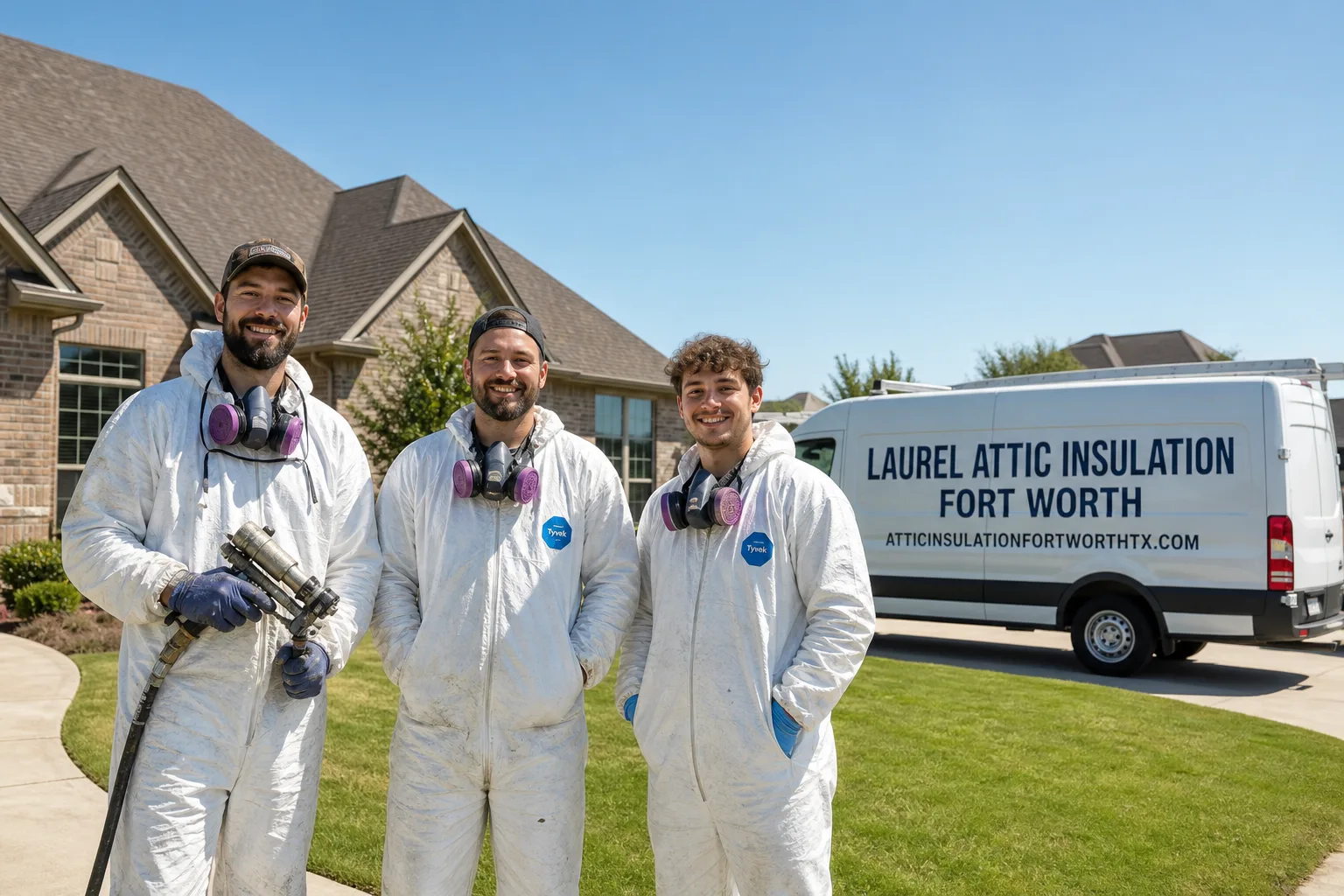
How Much Does Wall Insulation Cost in Fort Worth?
Wall insulation in Fort Worth typically costs $1,800 to $5,600 for an average 1,500 to 2,200 square foot home, with most homeowners paying around $2.40 to $4.10 per square foot of wall area. Blown-in cellulose or fiberglass for existing walls runs $1,400 to $3,200, while spray foam insulation for walls runs higher at $3,200 to $7,800 depending on whether you choose open-cell or closed-cell foam. These are real ranges we quote every week across Tarrant County, and they include labor, materials, and the written guarantee that comes with every Laurel Attic Insulation job.
If you want a fast, exact number for your house, call (817) 730-5474 and we’ll walk you through it in about ten minutes. No door-knocker pricing games. You get a written price before anything starts.
Wall Insulation Cost Breakdown (2026)
Here’s what we’re actually charging for wall insulation work in the Fort Worth market right now. These numbers reflect our 2026 pricing for existing single-family homes, not new construction, which is a different animal because the walls are open before drywall goes up.
| Insulation Type | Typical Cost (Installed) | Best For |
|---|---|---|
| Blown-in fiberglass (existing walls) | $1,400 – $2,800 | Retrofit jobs, older homes with empty wall cavities |
| Blown-in cellulose (existing walls) | $1,600 – $3,200 | Dense-pack retrofits, sound control, tighter air seal |
| Open-cell spray foam (new construction or open walls) | $3,000 – $5,400 | Interior walls, garage-to-house shared walls, sound dampening |
| Closed-cell spray foam (new construction or open walls) | $4,800 – $7,800 | Exterior walls in flood-prone areas, max R-value per inch |
| Fiberglass batts (open wall cavities) | $900 – $1,900 | Garage conversions, additions, accessible stud bays |
| Wall cavity injection foam (slow-rise) | $2,600 – $4,400 | Existing walls where drywall stays up, no demo needed |
Now, what drives those numbers up or down? Square footage of wall area is the obvious one, but here’s what actually moves the needle in Fort Worth homes. The age of your house matters more than people think. Homes built before 1980 in neighborhoods like Ridglea, Ryan Place, or Handley often have zero wall insulation, or the original rock wool batting has settled into a sad little pile at the bottom of each stud bay. That means more material, more labor, and sometimes more prep work to access the cavities. Homes built between 1980 and 2005 usually have some batt insulation, but it’s often installed poorly: gaps around electrical boxes, compressed behind wiring, missing entirely in weird spots. Adding dense-pack cellulose on top of that old work runs on the lower end of our ranges because the cavities are partially filled and we’re topping off, not starting from zero.
The number of accessibility cuts also matters. On a retrofit, our crew drills access holes through the exterior or interior wall surface, fills the cavity, and patches. If your home has brick veneer, which is very common across Fort Worth, we typically drill from the interior side to avoid damaging the brick, which changes the patching and paint touch-up scope. If you have stucco, we go through the stucco and patch with a color-matched finish. None of this is wildly expensive, but it’s not free either, and it’s the kind of local detail that doesn’t show up on generic insulation pricing pages.
What Affects Wall Insulation Pricing in Fort Worth
- R-value targets in North Texas climate. The Department of Energy recommends R-13 to R-15 for walls in our climate zone. But many Fort Worth homeowners chasing lower utility bills from June through September opt for R-19 or higher in wall cavities when space allows. Higher R-value means more material, so expect the cost to climb about 12% to 18% when you jump from R-13 to R-21 closed-cell foam or dense-pack cellulose.
- The age and construction style of your home. A 1920s Craftsman in Fairmount has plaster walls and balloon framing, which means fire-blocking issues and trickier cavity access. A 1990s tract home in Wedgwood has straightforward 2×4 framing and standard drywall, which is faster and cheaper to work in. The per-square-foot price can swing $0.50 to $1.20 just based on what we’re drilling into.
- Whether the wall cavity is open or closed. If you’re doing a remodel or building an addition, walls are open and we’re installing batts or spray foam directly into exposed stud bays. That’s the cheapest labor scenario since there’s no drilling or patching. Existing closed walls always cost more because of the drill-and-fill process. If your drywall is already coming down for a renovation, tell us early so we can schedule the insulation while the walls are open.
- Brick veneer versus siding. Most Fort Worth homes have brick. When brick is on the exterior, we access wall cavities from inside the house, which means patching interior drywall and repainting. Siding homes can usually be drilled from the exterior, which is less intrusive to your living space but requires color-matched siding patches. Either way, the access direction changes the total price.
- Access and clearance around the perimeter. Tight side yards, dense landscaping, a pool cage, or an outside AC unit pushed right up against the wall all slow down the crew. If we have to remove and reinstall a section of fence or work around foundation plantings you don’t want touched, that’s labor time. We flag these before work starts so the written price covers the real scope.
- Air sealing work bundled with wall insulation. Many homeowners in Fort Worth ask us to air-seal top plates, rim joists, and electrical penetrations while we’re working in the walls. It adds $250 to $700 on most jobs, but it’s the single highest-ROI add-on we sell because it stops the stack effect that pulls hot outside air into your walls in August.
How Much Does Wall Insulation Save on Energy Bills in Fort Worth?
Here’s the number we hear most often from customers after their first full summer post-insulation: 18% to 32% lower cooling costs, with the higher end coming from homes that had zero insulation before. For a 2,000 square foot Fort Worth home running AC from late May through early October, that translates to roughly $45 to $95 per month during peak cooling season. You can do the math on payback: a $3,000 wall insulation job that saves $70 monthly during the six warm months pays for itself in about 3.5 years, before you even count the comfort improvement in rooms that used to feel like ovens by 3 p.m.
Utility data from Oncor’s service territory, which covers Fort Worth, shows homes with upgraded insulation and air sealing reduce whole-home energy usage by 9% to 14% annually. That’s not a savings guarantee from us, just the real-world pattern we see in this market. Your attic insulation matters more than your walls for raw bill reduction, but walls are a close second, and if your attic is already done, walls are the logical next project. If you’re unsure where to start, call (817) 730-5474 and we’ll tell you honestly whether walls or attic should come first based on your house.
Wall Insulation Materials We Install in Fort Worth
We match insulation material to the job, not to whatever is left on the truck. For wall retrofits in Fort Worth, we use dense-pack cellulose from GreenFiber or Johns Manville more often than anything else, because cellulose compresses into wall cavities better than fiberglass and gives a real air-sealing benefit. For open walls, we lean on fiberglass batts from Owens Corning or Knauf when the budget is standard, and Rockwool batts when the homeowner wants fire resistance and sound control. For foam, we’re certified to install Icynene open-cell and Demilec closed-cell products, both of which handle North Texas humidity well. Every material choice goes in writing before work starts, so you’ll see exactly what’s going into your walls and what it costs.
One thing worth knowing about Fort Worth’s climate: we’re in a mixed-humid zone, which means your wall assembly needs to handle moisture from both sides. A vapor barrier installed on the wrong side of the wall in this climate can trap moisture inside the cavity and feed mold. This is one of the practical reasons we don’t do one-size-fits-all recommendations. The wall construction, the exterior cladding, and whether you have existing moisture issues all play into what we spec.
How Wall Insulation Is Installed: What to Expect
For an existing home, here’s how a typical retrofit goes. Our crew marks out the stud bays, drills a 2 to 2.5 inch access hole in each cavity, and then dense-packs insulation through a hose at controlled pressure. The key to a good dense-pack job is hitting the right pounds-per-cubic-foot density, about 3.5 lbs for cellulose, which prevents settling and gives you the air-sealing benefit. Then we patch the holes, texture-match where needed, and leave the walls ready for paint. Most full-home retrofits in Fort Worth take one to two days depending on house size, and we work around your furniture with floor protection and dust control.
For open-wall projects, the process is different. Stud bays are exposed, insulation goes in with batts or spray foam, and then drywall goes up after we’re done. If you’re working with a general contractor on a remodel, we coordinate directly with them so insulation doesn’t hold up the drywall crew. We’ve done enough jobs across Fort Worth that we know the rhythm of remodel schedules and the inspectors who sign off.
A quick note on safety: spray foam installation requires proper ventilation and protective equipment. Closed-cell foam off-gases during installation, and the two-part chemical reaction generates heat. This is not a DIY project, and it’s not something you want an inexperienced crew doing inside your home. Our technicians are trained and equipped for foam work specifically, and we follow the manufacturer’s installation requirements on every job.
How to Save on Wall Insulation in Fort Worth
Wall insulation is one of those projects where the bid range can be wide, so here’s how to keep your cost in the lower band without sacrificing quality. First, consider doing walls and attic in the same project. You’ll save on mobilization costs, and if you’re in Tarrant County, you may qualify for Oncor’s residential efficiency rebate program, which pays per square foot of upgraded insulation. The rebate amounts shift seasonally, but the program has been paying out consistently for years. We’ll check your eligibility before we quote.
Second, don’t insulate walls you don’t need to insulate. Interior walls, for example, don’t need thermal insulation unless you’re trying to soundproof a home office, nursery, or media room. Exterior-facing walls are where your cooling dollars leak. A north-facing wall under a covered porch might need more insulation than a west-facing wall with brick veneer and afternoon shade from a mature oak tree. We’ll tell you where the money is worth spending.
Third, handle the prep work yourself. If you can move furniture, clear the perimeter, and remove wall hangings before we arrive, that’s labor time we don’t have to bill for. On dense-pack retrofits, access prep can save you $100 to $300 depending on the house.
Finally, get at least two quotes, but make sure you’re comparing the same material and scope. A $2,000 bid that uses loose-fill fiberglass at low density is not the same job as a $2,900 bid that uses dense-pack cellulose with air sealing at the rim joist. The cheapest wall insulation quote in Fort Worth is usually cheap because something is being left out. We’d rather give you a higher number up front and a better wall five years down the road. Free estimates mean you can call (817) 730-5474 and we’ll scope the job properly without any obligation.
FAQs – Wall Insulation Cost
How much does it cost to insulate existing walls in Fort Worth?
Insulating existing walls in a Fort Worth home typically costs $1,400 to $3,200 using dense-pack cellulose or blown-in fiberglass, and $2,600 to $4,400 if you choose injection foam. The exact number depends on square footage, wall access, and whether drywall patching is needed on the interior or exterior side. Call (817) 730-5474 for a written quote specific to your house, and we’ll include every line item so there are no surprises.
Is wall insulation worth the cost in Texas?
Yes, and the numbers support it. Most Fort Worth homeowners see an 18% to 32% reduction in summer cooling costs after upgrading wall insulation, with payback typically landing between 3 and 5 years. Comfort matters too: walls that used to radiate heat at 4 p.m. in August hold their temperature much better once the cavities are filled. Chase Whitaker, who runs our Fort Worth operation, has been doing this work since 2003 and will give you an honest read on whether your house would benefit.
Can you insulate walls without removing drywall?
Yes, and that’s exactly what a dense-pack or injection foam retrofit does. We drill small access holes into each stud cavity, fill the wall with insulation at controlled density, then patch and texture the holes. This method works on most Fort Worth homes built with standard 16-inch on-center framing. The whole process takes one to two days for a typical house, and we handle the patch work to match your existing wall finish as closely as possible.
How much does spray foam wall insulation cost in Fort Worth?
Open-cell spray foam for wall cavities runs $3,000 to $5,400 for a typical Fort Worth home, while closed-cell foam runs $4,800 to $7,800. Closed-cell costs more per inch but delivers roughly double the R-value and acts as a vapor barrier, which matters in our humid climate. For existing homes with closed walls, we typically recommend dense-pack cellulose over spray foam unless the walls are already open for a remodel.
Does wall insulation add resale value in Fort Worth?
Wall insulation doesn’t have the flashy resale value of a kitchen remodel, but it shows up in inspections and energy disclosures. Buyers in Fort Worth increasingly ask about insulation and utility bills, and a documented wall insulation job with a written guarantee transfers a real sense of confidence. It’s not uncommon for homes with full envelope upgrades to command a premium, especially in older neighborhoods like Ryan Place or Berkeley where original homes had no insulation at all. The stronger day-to-day argument is the comfort and bill savings while you live there.
Can you insulate my walls today?
We can usually get a retro-fit wall insulation job scheduled within 3 to 5 business days in Fort Worth, depending on current crew availability. If you call (817) 730-5474, a live person answers 24/7, and we can get you on the schedule fast. Every job includes a written price before work starts, so you’ll know the cost the same day we scope it.
Why Fort Worth Homeowners Choose Laurel Attic Insulation
We got our start in 2003, and we’re part of the Relay Home Co. family of independent local home-service businesses. The Relay Visibility Guarantee means you get a live arrival time with technician tracking, before-and-after photo proof of every job, and a written price before anything starts. You don’t wait through a four-hour window wondering if anyone is showing up.
Every wall insulation job includes our 365-Day Done Right Promise in writing. If something isn’t right within a full year, we come back and make it right. And if a repair fails, the second visit is free, no charge and no argument. That’s not marketing language. It’s the way we’ve operated since day one, and Chase Whitaker stands behind every job we do in Fort Worth. Our Wall Insulation in Fort Worth service page has more detail on how the process works, and our home service area covers the entire Fort Worth metro.
We stock professional-grade materials from Owens Corning, Johns Manville, Knauf, Rockwool, CertainTeed, Icynene, Demilec, and GreenFiber. That matters because different wall assemblies need different products, and we’d rather match the material to your house than force one product into every situation. Some companies sell whatever they have on the truck. We spec what your walls actually need.
Our techs are background-checked and uniformed, and they arrive at a live, trackable time through the Relay app, just like you’d track a delivery. The name Laurel has a meaning for us: laurel stays green all year, and that’s the idea we bring to your home’s comfort. It shouldn’t fluctuate with the seasons, and with properly insulated walls, it doesn’t.
If you’re ready to stop watching your AC run nonstop through another Fort Worth summer, call us. The estimate is free, the price is in writing, and the work is guaranteed for a full year.
Pricing reflects the Fort Worth market as of 2026. Laurel Attic Insulation Fort Worth offers free estimates – call (817) 730-5474.
Written by Chase Whitaker, Owner at Laurel Attic Insulation Fort Worth, serving the Fort Worth metro since 2003.
What Our Customers Say
"Quote in the app was clear on R-value and price."
- Doris L."Air sealing around the hatch and can lights. Tidy and quick."
- Mack R."Utility bill dropped the next month. Our summer electric bill was lower by a visible amount."
- Gary J.