
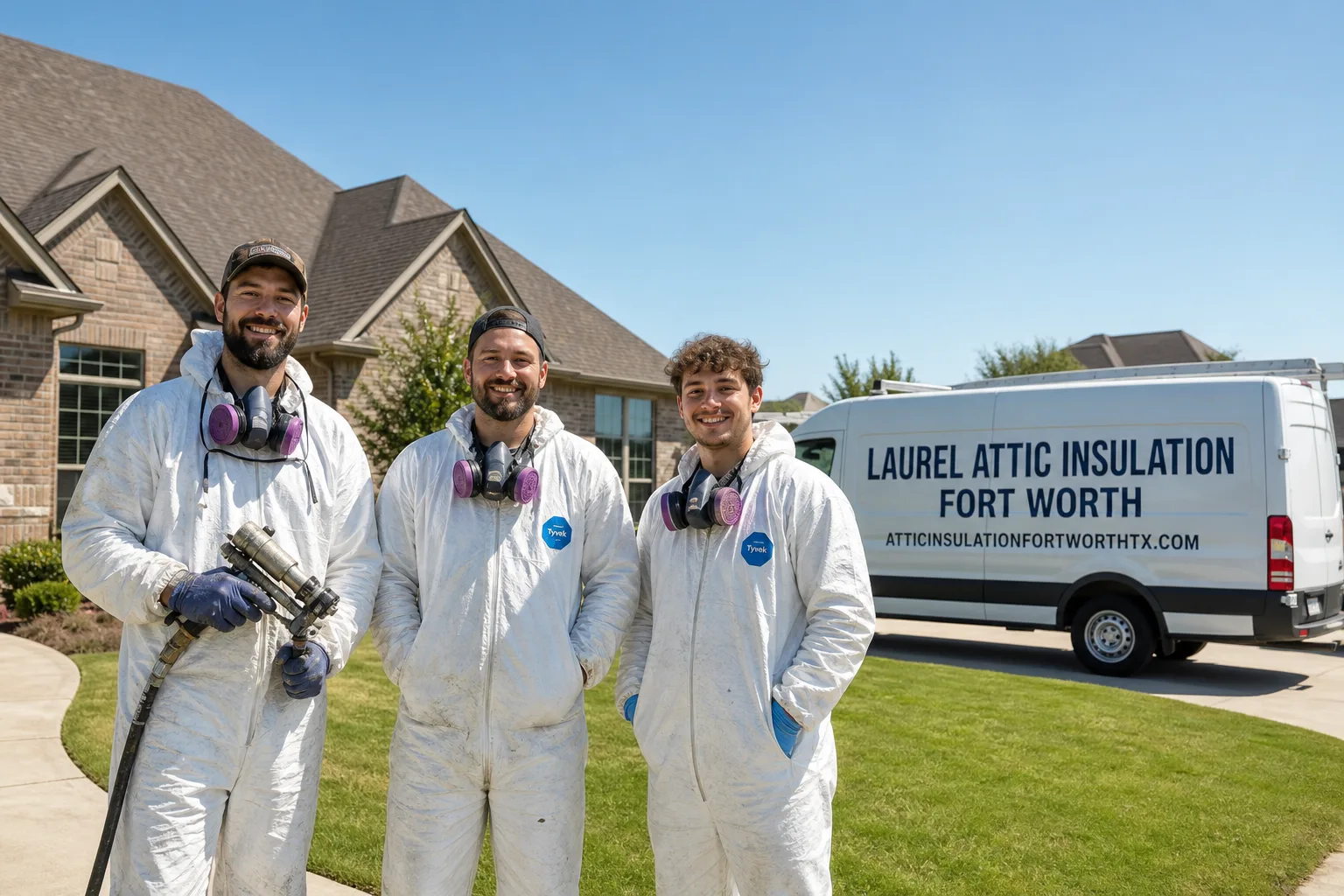
Fast, Reliable Spray Foam Insulation Across Fort Worth
Spray foam insulation in Fort Worth typically costs $1.50 to $4.50 per board foot installed, with full attic jobs for a 1,800-square-foot ranch home running $3,800 to $7,200. We dispatch crews from our Dallas-Fort Worth office directly into Fort Worth neighborhoods daily, and most jobs are scheduled within three to five business days. If your summer electric bill has you wincing and your upstairs still won’t cool below 80°F, call (817) 730-5474. We show up when we say we will, and the price we quote is the price you pay, in writing, before a single can of foam is opened.
Why Laurel Attic Insulation Fort Worth Is Fort Worth’s Preferred Spray Foam Insulation Company
Fort Worth homeowners call us because we speak the local language. We know a pier-and-beam bungalow in Fairmount from a slab-on-grade brick ranch near Eastchase, and we treat them differently because they fail differently. Our techs have opened enough cathedral ceilings in Ridglea Hills to know what compressed R-11 looks like after forty years in a 150°F attic. That familiarity means we diagnose faster and quote accurately the first time.
Chase Whitaker leads our Fort Worth insulation team and holds every job to the Relay Visibility Guarantee. That means when you book, you get a live arrival time, not a four-hour window. Your technician is background-checked and uniformed. You receive before-and-after photos from inside your own attic, so you can see exactly what was removed and what went in. And the written price arrives before work starts, every time.
We’re part of the Relay Home Co. family, founded in 2003. Every spray foam job in Fort Worth includes the 365-Day Done Right Promise: if it’s not right, we make it right, and we back that in writing. No arguments, no charge, no second visit fee. If a repair fails, the second visit is free.
Spray Foam Attic Insulation in Fort Worth
Spray Foam Attic Insulation in Fort Worth is the single most effective upgrade for homes built between 1950 and 1985, which represent a huge share of the city’s housing stock. Most of these attics were fitted with R-19 fiberglass batts that have settled, been trampled by AC crews, or were never installed properly to begin with. We remove the old material when needed, air-seal penetrations, and apply open-cell or closed-cell foam directly to the roof deck or attic floor. The result is an attic that stops acting like a solar oven.
On a 1,500 to 2,000-square-foot ranch in Fort Worth, spray foam attic insulation typically runs $3,200 to $6,800 depending on depth, access, and whether we’re converting a vented attic to a sealed conditioned space. It’s not the cheapest option on paper. It is the one that actually changes how the house feels in July.
Cathedral Ceilings and Hot Rooms
Ridglea Hills and the TCU area are full of 1970s contemporaries with vaulted or cathedral ceilings. The cavity between the drywall and the roof deck often holds nothing but a thin layer of fiberglass that’s been cooked for decades. We spray closed-cell foam directly into those cavities. It seals, it insulates, and it stiffens the roof assembly. The rooms below finally track the thermostat.
We worked a 1978 contemporary in Ridglea Hills where the upstairs bedrooms stayed above 82°F even with the AC running nonstop. Our tech opened the cathedral ceiling cavity and found original, compressed R-11 fiberglass and no air barrier. We removed it, air-sealed the eaves, and sprayed Demilec closed-cell to R-30. The owner called back in August to say the upstairs finally matched the downstairs thermostat. That’s the job, right there.
Converting a Vented Attic
In Fort Worth’s east-side brick ranches, vented attics with soffit and ridge vents are standard. The problem: during a 100°F week, the attic hits 140°F and the R-19 on the attic floor is fighting heat from all sides. Spraying the underside of the roof deck with open-cell foam and closing the vents converts that furnace into conditioned space. Your ductwork, if it runs through the attic, stops losing cooled air into a superheated space. This is why spray foam changes the math for older Fort Worth homes that newer insulation won’t.
Spray Foam Wall Insulation in Fort Worth
Spray Foam Wall Insulation in Fort Worth is a job we do frequently in the city’s slab-on-grade brick ranches from the 1960s and 1970s, where the original construction often included zero exterior wall insulation. We drill access holes, either from the exterior or through drywall, and inject foam into each stud bay. It fills fully, unlike blown fiberglass that sags over time, and it air-seals every gap around outlets and at the top and bottom plates.
Expect $2,800 to $6,500 for a full exterior wall retrofit on a typical Fort Worth ranch, depending on square footage and whether we work from outside or inside. It’s invasive for one or two days, then it’s done, and the utility bill shows it. If the brick veneer is in good shape and the interior walls are open during a remodel anyway, the math gets even easier.
Pier-and-Beam Crawlspace Floor Insulation
Older Fort Worth neighborhoods like Fairmount are filled with pier-and-beam bungalows sitting over open crawlspaces. Heat and humidity come up through the floor year-round. In August, the crawlspace is 110°F and the floorboards feel warm underfoot. In January, the underside of the house is an icebox and the floors are freezing.
Spraying closed-cell foam to the underside of the floor joists from below solves both problems in a half-day. It insulates the floor assembly and acts as a vapor barrier at the same time. This is not a place where we’d recommend open-cell without a separate vapor barrier, and we’ll tell you that plainly.
Rim Joist Sealing for Comfort
The rim joist, the band around the outside edge of your floor framing, leaks air in almost every older Fort Worth home. You can feel it in winter: a cold draft at the base of the wall on the north side. We spray two to three inches of closed-cell foam on the rim joist from inside the crawlspace or basement. It stops most of that infiltration and is a straightforward, affordable job: $800 to $1,800 in most Fort Worth homes.
Trusted Brands We Service in Fort Worth
We install and service spray foam from Icynene, Demilec, and CertainTeed, three manufacturers with proven closed-cell and open-cell formulations for North Texas climates. We match the material to the job, not to whatever can is on the truck. For a Fort Worth roof deck that sees 140°F plus a winter freeze, we lean on Demilec’s closed-cell for its high R-value per inch and its structural stiffening. For a wall retrofit where moisture control matters, we look at Icynene’s open-cell. We keep local stock for most Fort Worth-area jobs and can turn small projects around in a few days. You won’t be waiting on a shipped pallet from out of state.
Common Spray Foam Insulation Problems We See in Fort Worth Homes
- DIY spray foam kits in pier-and-beam crawlspaces. Fairmount homeowners buy a two-part kit, crawl under the house, and spray a thin, uneven layer on the joists while leaving gaps at the rim and around plumbing. Moisture gets trapped against the subfloor, and we get called a year later when the floor starts to sag or smell musty.
- Open-cell foam on metal shop roofs without a vapor barrier. On acreage properties outside the loop, detached workshops with metal roofs get open-cell sprayed directly against the underside. Cold metal meets warm humid air, condensation forms, and drips onto tools and equipment. We fix this by removing the foam, addressing ventilation, and applying closed-cell with a proper vapor retarder.
- Foam sprayed over soffit vents in vented attics. East-side slab-on-grade brick ranches have vented attics by design. A contractor who doesn’t know better sprays right over the soffit vents, the attic stops breathing entirely, humidity spikes, and the roof deck warps. We always verify ventilation strategy before touching the gun.
- Cathedral ceiling cavities with no access. Ridglea Hills and TCU contemporaries hide minimal insulation behind drywall. We can’t see what’s there without opening a small access point. When we find nothing but cooked R-11, the fix is closed-cell foam injected into the cavity, and it’s one of the most dramatic comfort improvements we do anywhere in Fort Worth.
Pricing for Spray Foam Insulation in Fort Worth, TX
For Fort Worth, open-cell spray foam runs $0.50 to $1.00 per board foot. Closed-cell runs $1.50 to $2.50 per board foot. A full attic on a 2,000-square-foot ranch in Rosedale or Wedgwood, moving from vented to sealed, lands between $4,200 and $7,800. A wall retrofit on the same house sits around $3,000 to $6,000. A crawlspace floor job on a Fairmount bungalow is $2,000 to $4,500. Those are installed prices, materials included. Your written quote comes before any work begins, and estimates are free: call (817) 730-5474.
We Also Serve Cities Near Fort Worth
Our crews run daily into Haltom City, Bedford, Colleyville, and Euless. If you’re a few minutes outside Fort Worth proper, we can usually schedule you within the same week. Learn more about our full Spray Foam Insulation services or see how we work across Fort Worth. Wherever you are in the metro, you get the same written price, live tracking, and photo proof.
Serving Fort Worth, TX - Our Local Coverage Area
We’re based in the Fort Worth area and know this community well. Use the map below to see our service coverage - if you’re nearby, we can almost certainly help.
FAQs About Spray Foam Insulation in Fort Worth
Yes. Ice dams form when heat escapes through your attic, melts snow on the roof, and the melt refreezes at the colder eaves. Spray foam seals the attic so heat stays out of the roof cavity, which stops the melt-and-refreeze cycle. On Fort Worth’s rare snow days, homes with sealed attics show far less ice buildup at the soffits. The fix is permanent, not seasonal.
The cathedral ceilings in those homes typically hold only R-11 fiberglass that has compressed over four decades. When the attic hits 150°F in July, the ceiling cavity radiates heat into the room all evening. We open the cavity, remove what’s there, and spray closed-cell foam to R-30. Rooms that wouldn’t drop below 82°F start matching the downstairs thermostat. Call (817) 730-5474 and we’ll tell you if your ceiling cavity is the likely culprit.
Yes, but choose the right foam and the right placement. On a metal-roofed workshop, open-cell sprayed directly against the roof underside can trap condensation and drip onto your equipment. Closed-cell applied with a vapor retarder is the safer call. The oversized door itself is usually a separate issue, often the biggest heat leak in the building. We can inspect the door opening and the roof deck in one trip and tell you exactly what’s needed. One trip, no guesswork.
Yes, and it’s one of the best upgrades for those homes. We spray closed-cell foam to the underside of the floor joists from below. That insulates the floor and creates a vapor barrier at the same time. It quiets the house, warms the floors in winter, and cuts humidity issues. The work is usually done in a single day and far outperforms fiberglass batts that sag and collect moisture in a crawlspace.
Absolutely. The original R-19 has likely settled to R-10 or worse, and the vented attic still bakes at 140°F in summer. We remove the old fiberglass, air-seal the attic floor, and spray open-cell foam on the roof deck or the floor, depending on your home. Most east-side ranches see the biggest jump from sealing the attic and adding R-38 or better. A full job on that house typically runs $3,800 to $6,500, and the written quote is free: call (817) 730-5474.
Written by Chase Whitaker, Owner at Laurel Attic Insulation Fort Worth.